If you drive in Waterloo Region long enough, you learn the pattern.
Winter ends. Snow melts. Roads look fine for a week. Then potholes start showing up everywhere—on the routes you take to work, on the way to school drop-off, and in those “I’ll just take the side streets” shortcuts through Kitchener and Waterloo.
Most pothole hits are annoying but manageable. You pull over, you find a safe spot, you swap a tire, and you move on.
But some pothole impacts are different. They can bend parts, damage steering or suspension, or leave your car unsafe to drive. And that’s where people make a costly mistake: they treat it like “just a flat,” then keep driving on a car that is no longer stable.
This guide explains the difference—what you can handle on the spot and what should be towed in Kitchener, Waterloo, and Cambridge.
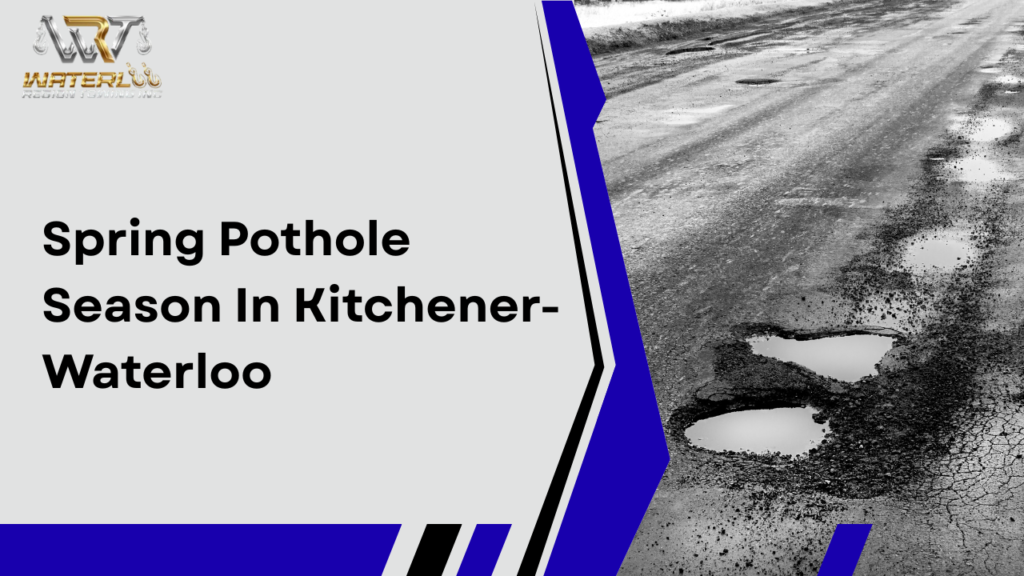
Why Spring Potholes Get So Bad In Waterloo Region
Potholes aren’t random. They grow fast when temperatures bounce around the freezing point.
Water gets into tiny cracks in the road. It freezes, expands, and forces the crack wider. Then it melts and leaves a gap. Add traffic on top, and the surface breaks apart.
Cities often do temporary winter repairs with cold-mix, then do more permanent hot asphalt fixes when conditions allow. That “temporary now, permanent later” approach is commonly described in local reporting on Waterloo Region potholes.
So spring pothole season hits hard because:
- freeze-thaw cycles have already weakened the surface
- meltwater gets into every crack
- traffic finishes the job
First: Pull Over Safely And Do A Quick Reality Check
Right after you hit a pothole, your brain goes straight to the obvious problem: “Did I blow a tire?”
That’s a good starting point, but don’t stop there.
Before you do anything else:
- slow down gently
- signal and pull into a safe spot (a plaza lot is better than a shoulder)
- turn on hazards
- take a breath
Then do a quick check:
- Is the car pulling hard to one side?
- Is the steering wheel suddenly off-centre?
- Do you hear scraping, grinding, or loud metal noises?
- Is the car bouncing like it has no control?
If any of those are happening, don’t keep driving.
When It Really Is “Just A Tire” (And A Swap Makes Sense)
A tire swap is reasonable when:
- the car is sitting level (not leaning hard)
- you can see a clear flat tire with no obvious wheel damage
- the car was driving straight before you pulled over
- there’s no fluid leaking
- there’s no grinding noise when you roll slowly
If you put on the spare and the car drives normally at low speed, you can often get to a tire shop.
But even then, go easy. A spare is not meant for highway cruising.
Signs You Need A Tow After A Pothole Hit
This is the important part.
Below are situations where a tow is the smarter and safer decision in Waterloo Region—even if the tire is flat and you think you can “just make it.”
1) The Rim Is Bent Or Cracked
If you see:
- a bent rim lip
- a crack
- the tire bead not seated correctly
- a tire that won’t hold air even after inflating
…don’t drive it.
A bent rim can cut the tire, cause sudden air loss, and create vibration that damages other parts. It can also make the car unpredictable at speed.
If the rim is damaged, you’re not dealing with a normal tire change anymore.
2) The Car Pulls Hard Or The Steering Wheel Is Crooked
If your steering wheel is suddenly off-centre, or the car pulls strongly to one side, it can mean:
- alignment damage
- a bent tie rod
- a damaged control arm
- suspension shift from impact
That’s not “minor.” Steering components are safety-critical.
Driving on that can turn a repair into a bigger repair, or worse, cause you to lose control.
3) Loud Clunking, Knocking, Or Grinding After The Impact
A pothole can hit harder than people expect. If you hear:
- clunks over bumps
- knocking when you turn
- grinding that wasn’t there before
…something may be loose, bent, or rubbing.
That’s a tow situation. A loose part can fail completely.
4) A Sudden Vibration That Wasn’t There Before
If the wheel shakes or the whole car vibrates above a certain speed, you may have:
- a bent rim
- tire sidewall damage
- suspension damage
- a wheel bearing problem triggered by impact
Vibration is not just “annoying.” It’s a sign something is no longer rotating true.
5) A Visible Fluid Leak
If you see fluid pooling or dripping after a pothole hit, do not drive.
A pothole can crack:
- an oil pan
- a transmission pan
- a coolant line
- power steering components (in some vehicles)
Driving without fluid can destroy an engine or transmission quickly.
6) Airbag Light, ABS Light, Or Stability Control Warnings
In many modern cars, a hard impact can trigger sensor issues. If warning lights show up right after the hit—especially ABS or stability control—don’t ignore it.
Those systems matter in rain, snow, and emergency braking.
If the car feels unstable and warning lights are on, call for a tow.
7) The Car Feels “Loose” Or Bouncy
Sometimes the tire looks fine, but the car feels like it’s floating or bouncing more than normal.
That can be:
- a blown shock/strut
- a damaged spring
- a shifted suspension mount
If the car feels unsafe, trust that instinct.
What To Do Right After The Pothole Hit
Step 1: Take Photos If It’s Safe
Get:
- the pothole (wide shot + close shot)
- the street signs or a recognizable landmark
- your vehicle damage (wheel, tire, underbody if visible)
You’re doing this for two reasons:
- it helps if you’re dealing with insurance
- it helps if you report the pothole to the city
Step 2: Don’t Let The Car “Limp Home” If Steering Or Suspension Feels Off
A lot of people in Waterloo Region make this choice because they’re close to home.
It’s not worth it.
A tow is cheaper than:
- destroying a tire and rim completely
- damaging suspension further
- risking a second accident
Step 3: If You Need A Tow, Choose The Destination
Decide where you want the car to go:
- your trusted shop in Kitchener or Waterloo
- a dealership in Cambridge
- your home (if you’re parking it safely until a repair appointment)
This matters because storage yards can create extra hassle and added costs.
Reporting Potholes In Kitchener, Waterloo, And Cambridge
Reporting does two things:
- it helps prevent the next driver from getting hit
- it creates a record that the pothole exists
Here are the official reporting routes:
- City of Kitchener has a pothole reporting page and also lists a phone number (519-741-2345) for reports.
- City of Waterloo accepts pothole reports through its road/trail/sidewalk issue reporting form.
- City of Cambridge has an online pothole/road damage service request map tool.
When you report, include:
- exact location (street + direction + nearest intersection)
- which lane
- a photo if you can safely get one
Kitchener’s page specifically asks for location details like street, lane direction, and nearby cross streets.
“Can I Claim Anything If A Pothole Damaged My Car?”
People ask this a lot in spring.
There isn’t one simple answer because it depends on:
- road ownership and maintenance responsibility
- whether the municipality knew about the pothole
- whether it was repaired within the timelines that apply
- proof of damage and timing
What you can do immediately is protect your documentation:
- photos of pothole and damage
- date, time, exact location
- repair estimate from a shop
Even if you decide not to pursue a claim, this helps with insurance and repair decisions.
How To Avoid Pothole Damage In Waterloo Region
You can’t dodge every pothole. Sometimes you don’t see it until the last second.
But you can reduce damage risk with a few habits:
- Give yourself more following distance in spring so you can see the road surface ahead
- Be extra cautious on bridge approaches and areas with standing water (water hides depth)
- Keep tire pressure correct (underinflated tires get hit harder; overinflated tires can be less forgiving)
- Slow down on familiar “bad stretches” you already know in Kitchener-Waterloo
And one more honest point: if you see deep water across a lane, treat it like a hazard. It might be a pothole lake.
The Simple Rule That Keeps You Safe
If the car is only dealing with a flat tire and everything else feels normal, a tire swap may be fine.
If anything feels off—steering, vibration, scraping, warning lights, leaking fluid—don’t gamble.
In Waterloo Region spring, that gamble is how people turn a pothole hit into a bigger repair bill.
In case of assistance or any emergencies, you can reach out to Waterloo Towing for reliable services and guidance.