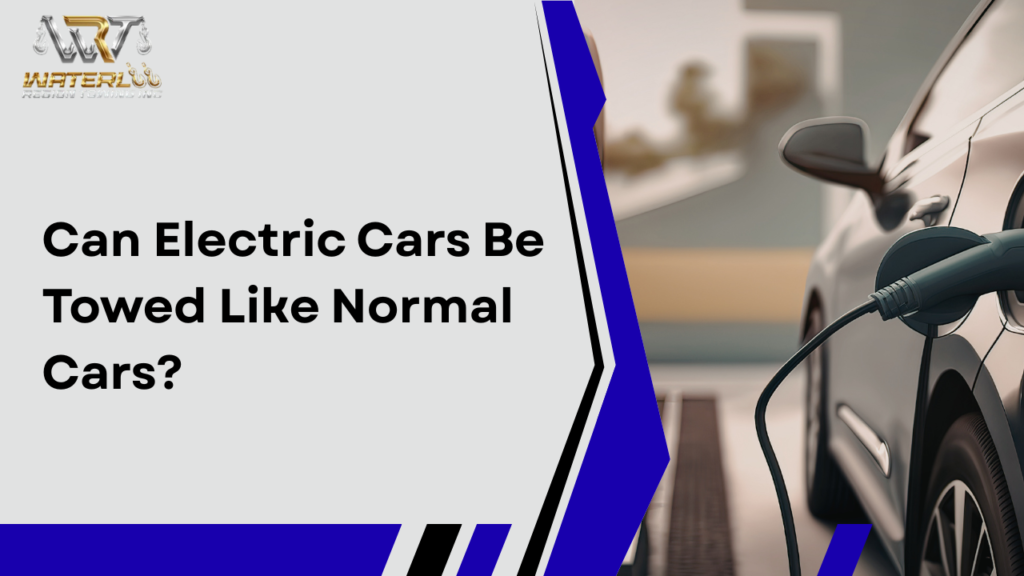
Electric vehicles are common in Waterloo, Kitchener, and Cambridge now. You see them everywhere—parked outside offices in Uptown Waterloo, lined up at chargers near big-box plazas in Kitchener, and commuting daily between cities on the region’s busiest routes.
But when an EV breaks down, gets a flat, or ends up in a collision, towing is not the same as any other car.”
A gasoline car can often be pulled with two wheels rolling on the road without major consequences. Many EVs cannot. The wrong tow method can damage the drive unit, overheat components, or create a warranty headache you never expected.
So let’s answer the real question clearly:
No, electric cars should not be towed like normal cars in most situations.
In Waterloo Region, the safest default is almost always a flatbed.
Why EV Towing Is Different
On an EV, the wheels are directly tied into systems that don’t behave like a traditional drivetrain.
Depending on the model, letting the drive wheels roll while the vehicle is “off” can do things you don’t want, like:
- spin the motor and electronics in an uncontrolled way
- trigger regeneration behaviour in odd conditions
- create heat where the vehicle can’t manage it properly
Manufacturers build towing guidance around this reality. For example, Tesla is very clear that “Tow Mode” is meant for winching onto a flatbed or for short repositioning only, and that exceeding very short distances or low-speed limits can cause significant damage not covered by warranty.
That’s not Tesla being dramatic. That’s Tesla trying to stop expensive drivetrain damage caused by improper towing.
The Safe Default In Waterloo, Kitchener, And Cambridge: Flatbed Towing
If you own an EV and you’re stranded, the most practical rule is this:
Ask for a flatbed tow where all four wheels are off the ground.
Independent automotive guidance and safety-focused industry sources repeatedly describe flatbed as the recommended method for EV transport because it avoids wheel rotation on the road.
Even if your EV is “just a dead 12V battery,” it can still be safer to fully charge it rather than try to pull it while the wheels are rolling.
Why flatbed matters in Waterloo Region specifically
Waterloo Region towing calls aren’t always simple. You may be dealing with:
- underground parking garages in condo buildings
- tight plazas and busy lots
- Winter ice, where controlled winching is safer
- high traffic corridors where you want the quickest, safest load-up
A flatbed gives the operator options: controlled winch, stable loading, and fewer “moving parts” during transport.
When People Get It Wrong: The Risky Tow Methods For EVs
1) Wheel-lift with the drive wheels rolling
This is where trouble starts.
If the wrong end of the vehicle is left on the ground and rolling, you can end up spinning components in ways the vehicle wasn’t designed to tolerate while powered down.
Some manufacturers do allow limited alternative methods only with dollies (so wheels don’t contact the ground), but the operator needs to know exactly what they’re doing. Kia, for example, notes flatbed as best, and if not available, describes lifting one end and placing the other wheels on a dolly to avoid ground contact.
2) “Just pull it a bit” when the vehicle is not in a safe towing state
This happens in parking garages and tight lots.
A driver might say, “We just need to drag it out to the open area.”
That can be a problem.
Tesla’s own guidance states that Tow Mode is intended only for short-distance repositioning or winching onto a flatbed, with strict limits.
That’s why the right approach is: controlled repositioning only if the manufacturer allows it, then load to a flatbed.
The Two EV Situations That Confuse People Most
Situation A: “My EV is dead. The 12V is drained. Do I still need a flatbed?”
Often, yes.
When the 12V is drained, the car may not:
- shift normally
- Release the parking mechanism properly
- allow safe movement without special procedures
This is exactly when people try to force a quick tow and end up causing damage.
The safe move is to tell dispatch:
- It’s an EV
- It’s not powering on normally
- You want a flatbed
Situation B: “It was in a small collision. It still looks okay.”
If an EV has been in a collision, you treat it with extra caution because you don’t know what happened underneath.
There are industry safety primers written for Ontario workplaces (including towing) that focus on EV hazards and why training and proper handling matter.
Towing industry discussions also flag that damaged EVs can bring unique fire risks and should be handled and stored with appropriate precautions.
You don’t need to panic. You just need to respect that an EV is not a normal “hook and go” situation after impact.
What To Tell The Tow Company In Waterloo Region (So The Right Truck Shows Up)
When you call for towing, your goal is to remove ambiguity. Don’t just say “I need a tow.” Say what matters.
Use this style of information:
- “It’s an electric vehicle.”
- “It will not drive / will not shift/is not powering up normally.”
- “I need a flatbed. I don’t want any wheels rolling on the road.”
- “It’s in an underground garage / tight lot” (if that’s the case)
- “It was in a collision” (if that’s the case)
If the dispatcher sounds unsure, don’t argue—just repeat:
“Please send a flatbed for an EV.”
What To Ask The Driver Before They Start
Even if a tow truck arrives, do a quick confirmation. You’re not being difficult. You’re preventing damage.
Ask:
- “Are you loading it fully on a flatbed?”
- “Can you confirm none of the wheels will be rolling during transport?”
- “Can you confirm the destination address?”
If they say they will wheel-lift it and roll wheels on the ground, stop and restate:
“It’s an EV. I want a flatbed tow.”
Paperwork Still Matters In Ontario
EV towing can be expensive. The method can be specialized. That’s exactly why you want the basics done properly.
Ontario requires towing and vehicle storage operators to have the proper certification to operate.
Before consenting to anything, make sure you understand:
- where your EV is being taken
- what you’re being charged for
- what you’re signing
Don’t treat this like a “small tow.” EV recoveries can turn into storage and extra handling quickly if you don’t choose the destination clearly.
Waterloo Region Reality Check: Garages, Condos, And Tight Access
A common Waterloo Region EV problem looks like this:
- The vehicle won’t start in an underground garage
- clearance is tight
- A flatbed can’t get close enough to load right away
In these cases, a skilled operator may need to:
- Reposition the vehicle carefully to a better loading area
- Then winch it onto a flatbed
That’s not automatically wrong. What matters is that the operator follows the manufacturer’s limits and doesn’t drag the car with wheels spinning freely on the ground.
This is why choosing an operator who understands EV recovery is not “extra.” It’s common sense.
The Bottom Line
If you drive an EV in Waterloo, Kitchener, or Cambridge and you need towing, keep it simple:
- Don’t assume an EV can be towed like a gas car.
- Flatbed is the safest default for most EV towing situations.
- Two modes are usually for winching/repositioning only, not for long-distance towing with wheels rolling.
- After a collision, treat the situation with extra caution and tell dispatch it’s an EV.
- In Ontario, work with properly certified towing operators and keep the destination and paperwork clear.
For reliable EV towing services, you can rely on Waterloo Region Towing for the best possible solutions.