Most people think towing is one simple service: a truck shows up, hooks your vehicle, and pulls it away.
That’s true for a lot of passenger vehicles. It’s not true for heavy vehicles.
In Waterloo Region, heavy towing is what you need when the vehicle is too large, too heavy, too damaged, or too stuck for a standard tow truck. That includes semi-trucks, loaded trailers, buses, RVs, straight trucks, cube vans, work trucks, and construction equipment. When these vehicles break down or end up off-road, the recovery isn’t just “pulling.” It’s controlled work that needs the right truck, the right rigging, and the right plan.
That’s where a 25-ton boom comes in.
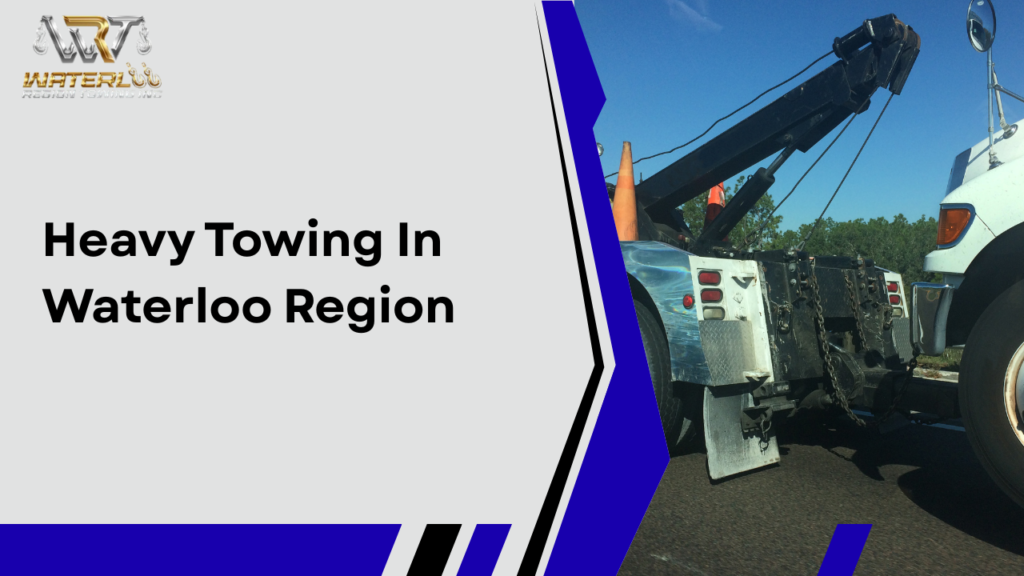
A 25-ton boom wrecker isn’t a marketing term. It’s a heavy-duty recovery setup designed to lift, winch, and stabilize heavy vehicles safely—especially when the vehicle is off-angle, in a ditch, blocking lanes, or in a location where a standard tow would make the situation worse.
This post explains, in plain language, when a 25-ton boom is actually needed in Waterloo, Kitchener, and Cambridge, what it’s used for, and what you should expect during a heavy recovery call.
What “25-Ton Boom” Really Means (Without The Confusing Parts)
A boom is the hydraulic arm on a heavy wrecker. It works with winches, cables, and rigging to recover heavy vehicles. The “25-ton” rating helps describe the boom’s lifting and pulling capability, but it does not mean the truck can lift 25 tons in every situation without limits.
Real recovery capacity depends on things like:
- Boom angle and extension (the farther it reaches, the less it can safely lift)
- Vehicle position (upright vs tipped vs jackknifed vs buried)
- Ground conditions (ice, mud, soft shoulder, slope)
- Load conditions (empty trailer vs loaded trailer)
- Recovery direction (straight pull vs side pull vs lift-and-rotate)
- Stabilization setup (outriggers, truck placement, counterweight balance)
That’s why heavy towing operators don’t rush a recovery. They assess first, then rig properly, then move the vehicle in controlled steps.
When You Actually Need Heavy Towing In Waterloo Region
Here are the most common real-world situations where a heavy wrecker with a 25-ton boom becomes necessary.
1) A Semi-Truck Or Trailer Is Disabled And Can’t Be Moved Safely
A semi with a mechanical failure might be able to roll, but towing it with basic methods may not be safe. Air brake issues, drivetrain failures, locked wheels, or steering problems can make “simple towing” risky.
If the truck is disabled in a live lane, the priority becomes:
- moving it safely
- avoiding further damage
- restoring traffic flow without creating a second incident
Heavy towing equipment is built for this, especially when the truck needs controlled pulling and stabilization to avoid shifting or snapping into an unsafe angle.
2) Winter Slide-Offs Into Ditches Or Soft Shoulders
Waterloo Region winters create the perfect conditions for heavy slide-offs:
- black ice on ramps
- drifting snow on rural stretches
- slushy shoulders that look solid but collapse under weight
A heavy vehicle that slides partially into a ditch can be deceptively hard to recover. The wrong pull angle can dig it in deeper or roll it further.
A 25-ton boom recovery is often used because it allows:
- controlled winching
- better stability using outriggers
- a safer, more calculated pull back to solid ground
This is also where you’ll sometimes see multiple winch lines or even more than one heavy unit on scene. It’s not overkill. It’s risk management.
3) A Loaded Trailer Situation
A loaded trailer changes the entire math.
A light wrecker may handle an empty unit in some cases, but a loaded trailer can require a heavy wrecker because:
- weight increases quickly
- Shifting cargo can change the balance during recovery
- Braking and rolling resistance are higher
- The trailer can jackknife during movement if not controlled properly
A proper heavy recovery will focus on stabilizing the vehicle first, then moving it in a way that prevents the load from worsening the situation.
4) Bus And Coach Towing (And Why It’s Not Like Towing A Truck)
Buses and coaches bring a different set of challenges:
- long wheelbase
- unique lift points
- fragile exterior panels
- passenger safety concerns if it’s a public vehicle incident
A 25-ton boom setup is often needed to handle the weight while maintaining the lift and pull points. The goal is to prevent body damage and avoid turning a mechanical breakdown into a costly structural repair.
5) RV Towing That Requires Heavy Equipment
RVs look like “big vans,” but they behave like heavy vehicles when things go wrong. They can have:
- rear overhang that scrapes easily
- unusual weight distribution
- delicate components underneath
- limited safe lift points
When an RV breaks down on a highway or ends up in a bad position, heavy towing is often the cleanest way to move it without bending or tearing components.
6) Construction Equipment Recovery Or Transport Support
Waterloo Region has constant construction and industrial activity. Equipment like skid steers, excavators, and loaders can end up needing recovery when:
- a machine breaks down on site
- It sinks into soft ground
- Access is tight, and pulling angles matter
Heavy-duty towing tools and controlled winching can safely move equipment, especially when the machine can’t roll normally or needs to be repositioned for transport.
7) Collision Recovery Involving Heavy Vehicles
When a heavy vehicle collision happens, recovery is rarely quick. The job often includes:
- scene assessment and stabilization
- clearing debris and creating a safe working space
- rigging with correct attachment points
- controlled pulling or lifting to undo the position
- towing or repositioning to a safer location
This is why heavy recovery scenes can take time. A rushed, heavy recovery can turn into:
- a rollover
- snapped lines
- further vehicle damage
- serious risk to workers and drivers nearby
What A Heavy Recovery Usually Looks Like On Scene
Even if you’ve never seen one up close, heavy recovery tends to follow a consistent pattern.
Step 1: Assessment
The operator looks at:
- what the vehicle is (tractor, straight truck, trailer, bus, RV)
- how it’s sitting (angle, traction, risk of roll)
- whether it’s loaded
- What the ground is doing under the tires
- What is the safest recovery direction?
Step 2: Stabilization
Heavy wreckers use outriggers and careful positioning. This is about keeping the recovery truck stable so it can pull or lift without shifting unexpectedly.
Step 3: Rigging
This is where experience shows. Proper rigging includes:
- selecting safe connection points
- choosing correct straps/chains
- setting winch lines at safe angles
- avoiding sharp edges and pinch points
Step 4: Controlled Movement
The operator doesn’t “yank.” Heavy recovery is typically done in slow steps:
- pull, pause, re-check
- adjust angles
- reposition if needed
- pull again
Step 5: Towing Or Relocation
Once the vehicle is back on stable ground, the job shifts to towing or staging:
- tow to a repair facility
- move to a safe pull-off
- stage for trailer handling or load transfer if needed
Local Reality: Why Heavy Towing Costs And Time Vary So Much
People often ask why heavy towing takes longer or costs more than expected. The answer is not a mystery. Its conditions.
Heavy towing changes based on:
- where the vehicle is stuck (ditch, shoulder, live lane, construction site)
- weather (ice, snow, rain, soft ground)
- load status (empty vs loaded)
- whether multiple trucks are required
- whether traffic control or police direction is involved
- how complex the recovery angle is
Two “same-looking” calls can be completely different jobs.
One Simple Way To Make A Heavy Tow Go Smoother: Give Better Info Up Front
If you’re a commercial driver, fleet manager, or dispatcher, the best thing you can do is provide clear details before the truck arrives.
When you call, be ready with:
- vehicle type (tractor-trailer, straight truck, bus, RV)
- whether it’s loaded, and roughly how (empty/partial/full)
- exact location (nearest intersection, exit, landmark)
- whether it’s blocking lanes
- whether the wheels are locked or damaged
- whether there are leaks or hazards
- whether it’s in a ditch or on soft ground
If you’re calling from a highway shoulder or a tight industrial yard, say that. It changes what trucks and tools are sent.
If you manage a fleet or drive commercially, calling Waterloo Towing with clear details upfront helps dispatch the right heavy unit faster.
Safety: What Regular Drivers Should Do Near Heavy Recovery Scenes
If you’re driving past a heavy recovery in Waterloo Region:
- slow down early
- follow lane closures without last-second swerves
- avoid rubbernecking
- Give workers space
Heavy recoveries often involve lines under tension and unstable vehicles. Even a small distraction from passing drivers raises risk.
Conclusion: Heavy Towing Is Not “Bigger Towing.” It’s A Different Job.
A 25-ton boom is used when the situation involves real weight and real risk—semi-trucks, trailers, buses, RVs, construction equipment, or any heavy vehicle that is stuck, damaged, off-road, or blocking traffic.
The main thing to understand is this: heavy recovery is planned work. The operator assesses, stabilizes, rigs, and moves the vehicle in controlled steps. That’s how you avoid turning a bad situation into a dangerous one.
Whether it’s a disabled semi, a bus, or equipment recovery, Waterloo Region Towing handles heavy towing in Waterloo Region with the right equipment and a controlled recovery process